
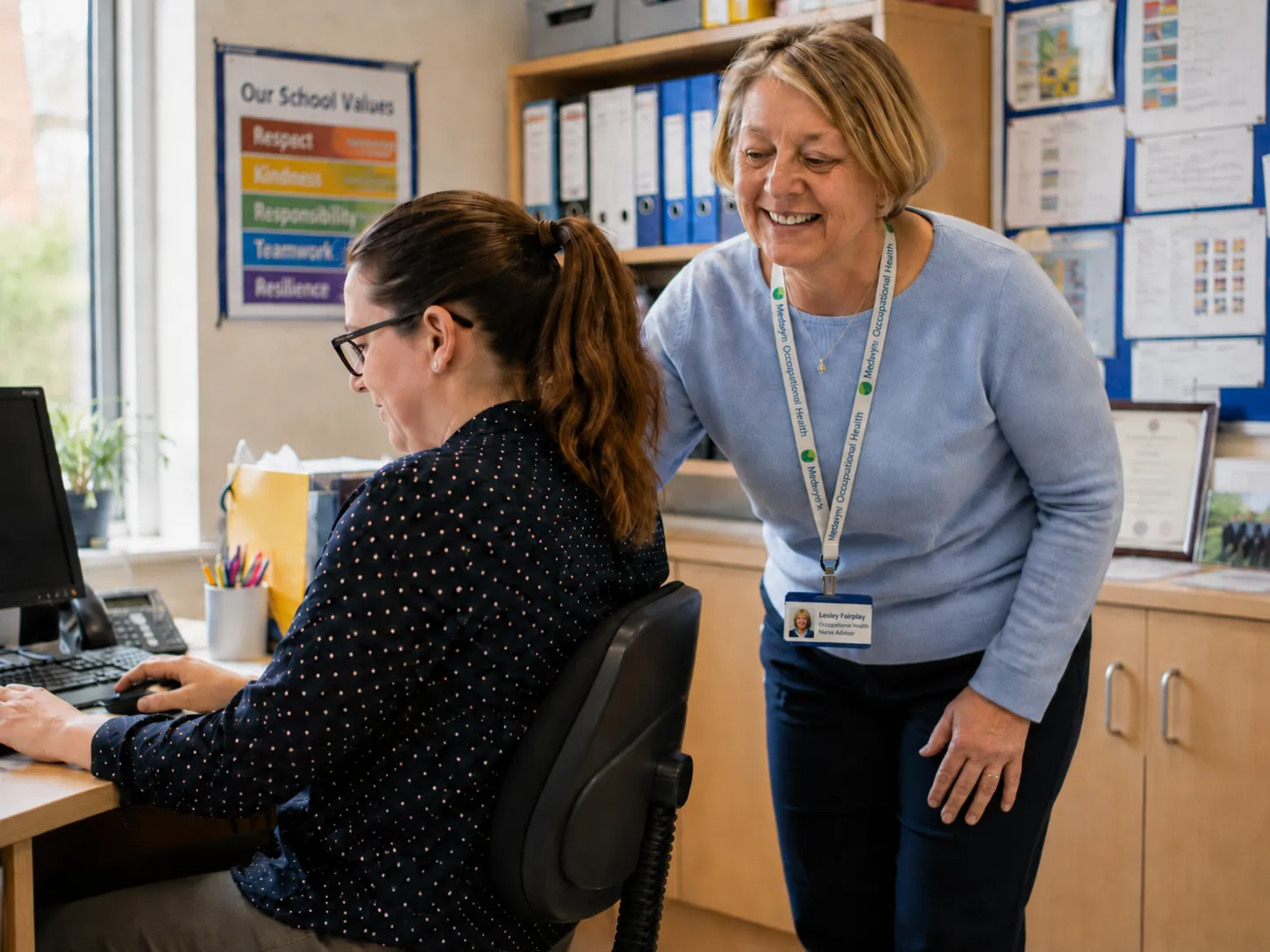
What is an ergonomic and DSE assessment?
An ergonomic or display screen equipment (DSE) assessment checks that a person's workstation fits them, rather than the other way round. Poor setup is one of the biggest drivers of back, neck and upper-limb problems, and getting it right early prevents pain, lost time and the cost that follows.
Where people use display screen equipment, you have specific duties under the DSE Regulations. We assess the setup, flag the risks and set out practical adjustments, at two levels depending on need.
We assess on site or remotely, wherever your people work.
Meet the clinical team →What a healthy workstation looks like
The same principles guide every assessment we carry out, at a desk or working from home. Explore the seven checkpoints, and the mistake we most often find at each.
Seven checkpoints to a healthy setup
Tap a number on the workstation, or a label below it, to see best practice and the mistake we most often find.
This is an indicative guide. A full assessment looks at the person, their tasks and how they actually work, and HSE is clear that workstation assessments should be carried out by someone with the right training. Our assessments are carried out by clinicians trained in ergonomic assessment, on-site or remotely.
What the law requires of employers
If your people use display screen equipment regularly, the DSE Regulations place specific duties on you as the employer.
Under the Health and Safety (Display Screen Equipment) Regulations 1992 (as amended 2002), where employees use DSE daily for continuous periods of an hour or more, you must:
- Assess workstations and reduce any risks you identify.
- Provide information and training so employees can use their workstations safely.
- Arrange eye and eyesight tests on request, and provide glasses where they are needed solely for screen use.
- Review the assessment when the user, the equipment or the workspace changes.
Where an employee has a health condition or disability, the Equality Act 2010 may also require reasonable adjustments – which is where a specialist assessment comes in.
Two levels, matched to the need
Not every person needs the same thing. We work at two levels, so you only pay for the depth each situation calls for – using a structured, recognised method and giving you clear, prioritised recommendations, with a risk rating where it helps you plan.
Standard DSE workstation assessment
A structured review of an employee's setup – screen, chair, desk, keyboard, mouse, posture and environment – against DSE requirements. For new starters, new workstations, routine reviews and anyone without current symptoms.
- Review of equipment, furniture and posture
- On-the-spot adjustments and practical advice
- Anyone needing a deeper assessment identified
- A written record to support DSE compliance
Specialist one-to-one ergonomic assessment
A longer, in-depth assessment for employees with a health condition, disability or pregnancy, those in pain or discomfort, or returning after injury. Carried out by a clinician trained in ergonomic assessment, who reviews the medical picture alongside the workstation.
- Discussion of the individual's health and symptoms
- Detailed postural and task analysis
- Specific, prioritised equipment and adjustment recommendations
- Reasonable-adjustment guidance under the Equality Act 2010
- A clear pathway into wider OH support where needed
Remote assessment of home and shared setups, by video.
Tailored to changing needs and comfort through pregnancy.
An efficient way to baseline a team and prioritise who needs a one-to-one.
Assessments flex to the role, too – from driving and control-room positions to retail and manual work.
From request to recommendations
Three steps, from your request to our written report.
Identify the need
A DSE trigger, a new symptom or a referral. We confirm which level of assessment fits.
The assessment
Standard or specialist, on-site or remote, looking at posture, equipment, environment and the task.
Report and recommendations
Clear, prioritised adjustments you can act on, set out in plain English.
Report within 72 hours of assessmentWhy employers choose Medwyn
We recommend only what will help, and explain why. Because we don't sell equipment, our advice is independent.
Assessments carried out by clinicians trained in ergonomic assessment, who consider the person's health alongside the workstation.
Office, home or hybrid, we assess people wherever they actually work, across the UK.
When an assessment uncovers something clinical, there is a clear route into our MSK and management-referral support.
Worsening wrist pain at home, resolved without time off
A hybrid worker reported worsening wrist and neck pain since moving to a laptop at the kitchen table. A remote assessment identified the screen height, an unsupported chair and a cramped keyboard position. With a riser, a separate keyboard and mouse, and a simple chair adjustment recommended, the symptoms settled and no time was lost.
Ergonomic and DSE FAQs
Answers to the questions HR and managers ask most.
If employees use display screen equipment daily for continuous periods of an hour or more, you must assess their workstation under the DSE Regulations. For most people without symptoms, a standard DSE assessment is enough.
A standard DSE assessment is the baseline check every regular screen user should have. A specialist ergonomic assessment is a longer, in-depth review for someone with a health condition, disability, pregnancy or pain, and considers reasonable adjustments under the Equality Act 2010.
Yes. We carry out homeworker and hybrid assessments by video call, giving the same practical advice as an in-person visit and the assurance that your duty of care extends to home working.
Employers must arrange and pay for an eye and eyesight test for a DSE user on request. Glasses are only the employer's responsibility where they are needed specifically for screen work, at the distance the screen is viewed; a general prescription is not the employer's duty.
Our report sets out prioritised recommendations, including any equipment that would help.
Our assessments are carried out by clinicians trained in ergonomic assessment, covering both standard and specialist levels. We deliver the report within 72 hours of the assessment.
Related services
Ergonomic assessments often work alongside these:
Musculoskeletal & physiotherapy
Assessment and rehabilitation when a problem is already present.
Learn more →Management referrals
Independent clinical advice when health affects someone's work.
Learn more →Health surveillance
Statutory monitoring, including DSE and vision where required.
Learn more →This page is general information for employers and is not individual medical or legal advice.
Arrange DSE and ergonomic assessments
Talk to us about ergonomic and DSE assessments for your team, on-site or remote. We answer enquiries within 3 working hours.