
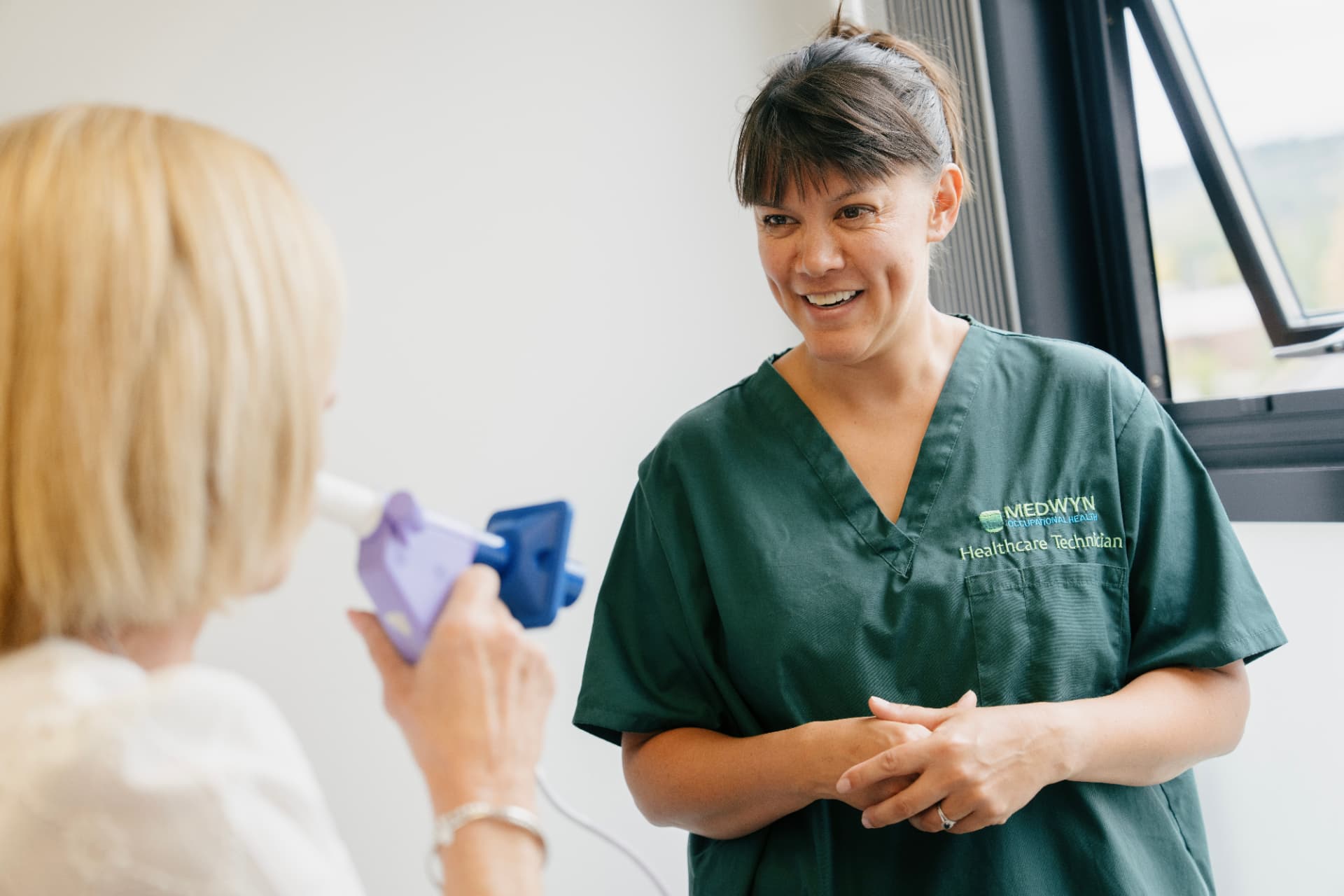
What is health surveillance?
Health surveillance is a programme of ongoing health checks for employees exposed to workplace hazards, such as noise, vibration, dust, fumes and hazardous substances, to catch the early signs of work-related ill health before they become serious or irreversible.
Where one-off screening is a snapshot, health surveillance runs throughout someone's employment in an at-risk role. Tracking results over time shows whether your risk mitigation is working, and lets you act before a manageable problem becomes a permanent disability.
For many employers it is not optional but a statutory duty, and exactly what's required depends on the specific hazards your people face. The tool below builds an indicative programme for your workplace, with the law behind each check.
Meet the clinical team →Build your indicative surveillance programme
Health surveillance is required where a risk assessment shows a residual risk of harm remains after your controls. Select the hazards in your workplace – or start from your sector – to build the checks that commonly apply, with the basis and the law behind each one.
Start from your sector
Physical agents
Hazardous substances
Work patterns & roles
Your indicative programme
Select the hazards in your workplace on the left, or start from your sector, and the checks that commonly apply will build here – each with its basis and the regulation behind it.
Some specifically named processes under COSHH Schedule 6 require surveillance regardless of the above; we confirm these against the regulations. Driver and offshore medicals (DVLA Group 2, OEUK Issue 8) sit under safety-critical fitness and are delivered via our Medicals hub.
How a Medwyn programme works
A managed programme built around your risks and run by a consistent clinical team.
Risk assessment review
We review your risk assessments to identify which hazards are present, who is at risk and what is legally required. Where no risk assessment is in place, we can advise.
Programme design
We design a programme around your workforce, hazards and operational calendar – surveillance types, frequencies and delivery method.
Baseline assessments
Employees entering at-risk roles are assessed at the start to set a health baseline, critical for hand-arm vibration (HAVS), audiometry and respiratory surveillance.
Ongoing surveillance
Scheduled on-site clinics at the intervals the regulations require. We manage the scheduling and prompt you ahead of each round.
Clinical review & escalation
Results are interpreted by qualified clinicians. Any concerns are escalated to a qualified occupational health physician with clear next steps.
OH physician review within 72 hoursReporting & assurance
Records and compliance held in our client portal, with real-time visibility of who is due, who is clear and what action is outstanding.
Health surveillance FAQs
Answers to the questions HR and safety leads ask most.
It depends on the hazards your employees are exposed to. Under COSHH, the Control of Noise at Work Regulations and the Control of Vibration at Work Regulations, health surveillance is a statutory duty where a residual risk of harm remains after control measures are in place. We can review your risk assessments and advise on what is required.
It finds the early signs of work-related ill health while they can still be acted on, and shows whether your control measures are working. Results tracked over time are also your evidence that the legal duty is being met.
Yes, where the risk assessment identifies exposure to noise, vibration, hazardous substances or another hazard the regulations name. The duty does not depend on the size of the employer.
Health surveillance is a legally required, ongoing programme of checks tied to specific workplace hazards, to detect early signs of occupational ill health in at-risk employees. Health screening is a broader, voluntary assessment of general health not linked to a particular hazard.
Frequency depends on the type of surveillance and the relevant regulations. Audiometry is typically annual; HAVS follows a tiered approach with a questionnaire then clinical review; spirometry is usually annual for at-risk workers. We design your programme with the correct frequencies built in and prompt each round.
Yes. Audiometry is a core part of our surveillance programmes for anyone exposed to workplace noise, as required under the Control of Noise at Work Regulations 2005. We take a baseline when someone enters the role, then repeat checks at the intervals the regulations require – on site at your premises or at our Surrey clinic.
Yes. Spirometry sits within our respiratory surveillance for employees exposed to dusts, fumes or respiratory sensitisers under the COSHH Regulations 2002, alongside symptom questionnaires. It helps catch the early signs of occupational asthma and other lung conditions while they are still manageable, with results reviewed by our clinical team.
Yes. Our hand-arm vibration (HAVS) surveillance follows the tiered approach set out under the Control of Vibration at Work Regulations 2005 – from screening questionnaires through to clinical assessment by an occupational health professional – for employees who regularly use vibrating tools or machinery. Baselines are taken before exposure starts wherever possible.
The result is reviewed by a clinician and, where needed, escalated to a qualified occupational health physician – typically within 72 hours. This may lead to a referral for further assessment, a recommendation to reduce exposure, or advice on adjusted working. You receive plain-language advice and clear next steps; the clinical detail stays confidential.
Where surveillance is legally required, employees are expected to participate as a condition of working in the at-risk role. They should be told clearly why it is taking place and what happens with the results, and we always talk through any concerns an individual has.
Yes. Our clinicians travel to your premises with the equipment for a full programme, and appointments at our clinic are also available.
Results and records are held in our client portal, which is GDPR compliant, with real-time visibility of programme compliance. Individual health records are confidential and not shared with managers without consent – only fitness-for-work outcomes and compliance data are reported.
Yes. A risk assessment is the starting point for deciding what is required, but we can advise on the surveillance appropriate for your sector and roles as a starting point, and recommend a health and safety partner to complete a formal assessment if you need one.
Related services
Health surveillance often works alongside these:
Pre-employment
Establishes the health baseline future surveillance is measured against, before day one.
Learn more →Drug & alcohol testing
Pre-employment, random and for-cause testing for safety-critical roles.
Learn more →Management referrals
Independent OH advice on fitness, adjustments and return to work once someone is in post.
Learn more →This page is general information for employers and is not individual medical or legal advice.
Set up a health surveillance programme
We design and deliver surveillance programmes, at your premises or our Surrey clinic. We answer enquiries within 3 working hours.