

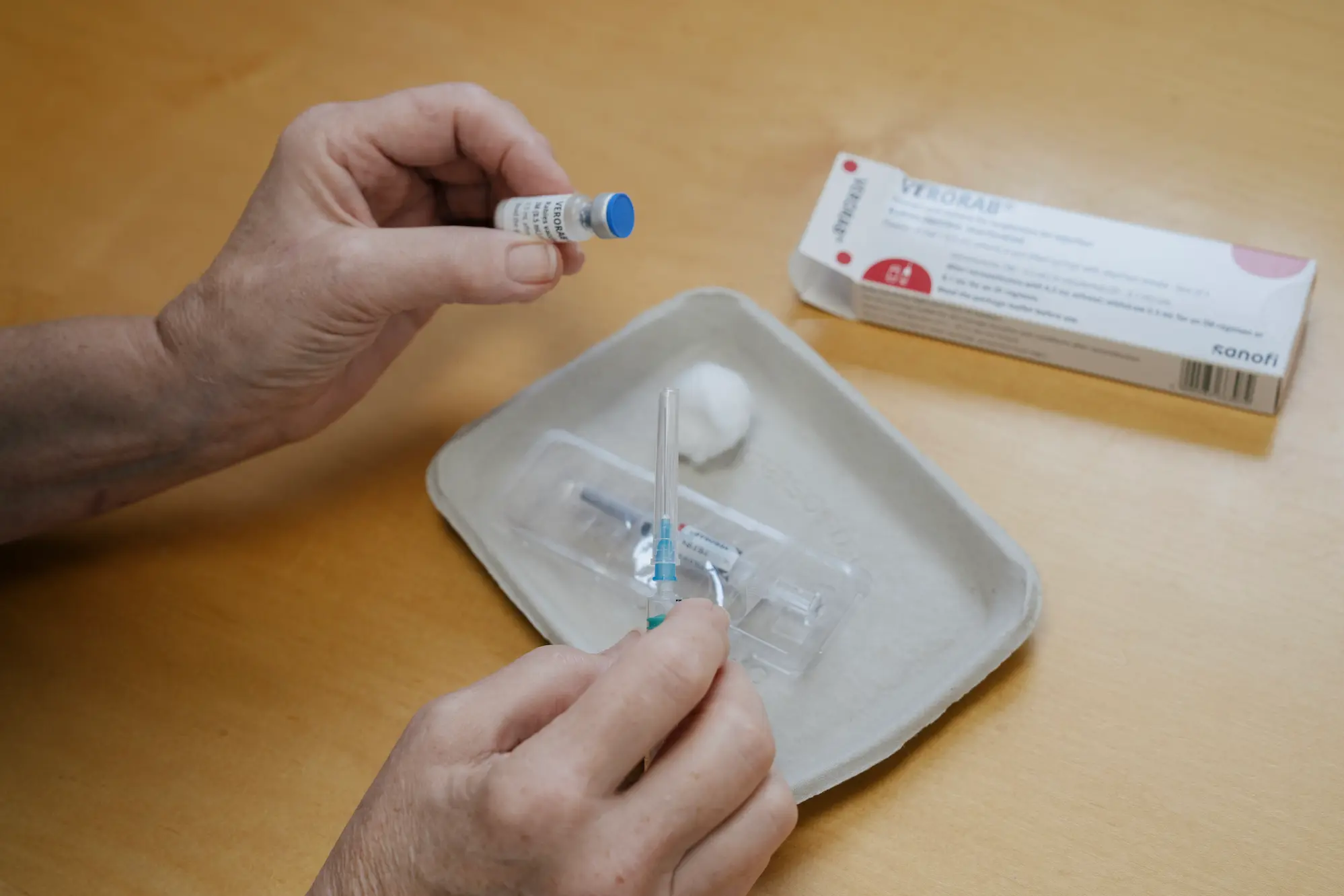
- Anyone with regular patient contact, including receptionists, needs evidence of protection against measles, rubella and chickenpox, a tuberculosis health check before starting and the offer of a yearly flu vaccine.
- For tetanus, diphtheria and polio, up to date means at least five doses in total, not a booster every ten years.
- Staff who may come into contact with blood need hepatitis B vaccination. Anyone who carries out exposure-prone procedures also needs clearance blood tests.
- The employer pays for vaccines needed for work. If someone declines or cannot have one, a local risk assessment is needed.
Healthcare workers need the occupational health vaccinations their role requires, and the Care Quality Commission (CQC) checks staff immunisation on inspection. NHS England's screening and vaccinations trust framework, published in April 2026, sets the baseline for NHS employees. It follows the national guidance that applies in GP surgeries, dental practices and independent clinics.
What the NHS England framework says
The framework sets the minimum health checks and vaccinations to confirm before a new member of staff starts. NHS England developed it with the UK Health Security Agency and the NHS Health at Work network, and it is due for review in April 2027. It follows chapter 12 of the Green Book, the national guidance on immunising healthcare and laboratory staff. The framework is written for NHS trusts, and the Care Quality Commission's guidance for GP practices also refers to the Green Book.
The framework covers staff who care for patients, non-clinical staff in healthcare settings, and laboratory and pathology staff. Staff who carry out exposure-prone procedures need further checks. Vaccines are considered according to each person's role and exposure, but the tuberculosis check and, where needed, exposure-prone procedure clearance are requirements. In the tables, 'Core' applies to everyone in the group and 'Depends on tasks' applies only where the role involves those tasks.
Up to date with tetanus, diphtheria and polio means five doses in total, not a booster every ten years.
What the law expects of employers
Under the Control of Substances Hazardous to Health Regulations 2002, employers must assess the risk of staff being exposed to infection at work. Where there is a risk and an effective vaccine exists, the Health and Safety Executive says employers should check whether each person is already protected and offer the vaccine to anyone who is not. Staff have the right to know whether a vaccine has protected them.
Care Quality Commission inspectors check staff immunisation in GP and dental practices. Dental inspection reports have asked practices to collect hepatitis B vaccination records and immunity results when they recruit staff.
Do employers have to pay for staff vaccinations?
Yes. The Green Book says employers must be able to show an effective staff immunisation programme, ideally run by an occupational health service, and must arrange and pay for it. This includes hepatitis B for staff exposed to blood. If you ask an employee to use their own GP, the Health and Safety Executive says you must refund any charge and make other arrangements if that is not possible.
Core vaccinations for staff who care for patients
This group covers anyone directly involved in patient care, such as doctors, dentists, nurses, midwives, healthcare assistants, paramedics, ambulance drivers, therapists, radiographers and pharmacy professionals. Students, trainees and volunteers who work with patients are included.
| Vaccination or check | Status | When it applies |
|---|---|---|
| Measles, mumps and rubella | Core | Two doses, or blood tests showing immunity |
| Chickenpox | Core | Definite history of chickenpox or shingles, two doses of vaccine, or a blood test showing immunity |
| Tuberculosis check | Core | Health check before starting, usually a questionnaire |
| Flu | Core | Offered every autumn |
| Tetanus, diphtheria and polio | Core | Full course of five doses |
| Hepatitis B | Depends on tasks | Contact with blood or body fluids, or a risk of sharps injuries or bites |
| Whooping cough | Depends on tasks | Maternity, neonatal and paediatric teams, and health visitors |
| BCG (tuberculosis vaccine) | Depends on tasks | Direct contact with tuberculosis patients, patients in settings with high tuberculosis rates, or clinical material that may be infectious |
| Exposure-prone procedure clearance | Depends on tasks | Before exposure-prone work, or hepatitis B tests only for renal unit staff |
Measles. See our article on measles and healthcare employers.
Chickenpox. Staff born or raised in a tropical or subtropical climate are offered a blood test whatever their history.
Tuberculosis. Staff from a country with high rates of tuberculosis who are new to the UK or the NHS are asked for UK-approved evidence of their current tuberculosis status, such as their visa tuberculosis certificate.
Hepatitis B. Under chapter 18 of the Green Book, the standard course is three injections over six months. When protection is needed sooner, three are given a month apart and a fourth at 12 months. A blood test one to two months after the course shows whether it has worked.
COVID-19 vaccination is not part of the framework.
Vaccinations for reception, administrative and support staff
This group covers staff who have social contact with patients but are not involved in their care, such as receptionists, ward clerks, porters, cleaners, café staff and estates workers.
| Vaccination or check | Status | When it applies |
|---|---|---|
| Measles, mumps and rubella | Core | Two doses, or blood tests showing immunity |
| Chickenpox | Core | Definite history of chickenpox or shingles, two doses of vaccine, or a blood test showing immunity |
| Tuberculosis check | Core | Health check before starting, usually a questionnaire |
| Flu | Core | Offered every autumn |
| Tetanus, diphtheria and polio | Core | Full course of five doses |
| Hepatitis B | Depends on tasks | Risk of sharps injuries or bites, or by risk assessment for cleaners and estates staff |
Not routinely neededBCG, whooping cough and exposure-prone procedure clearance
For cleaners and estates staff, the hepatitis B risk assessment looks at tasks such as handling clinical waste.
Staff with no contact with patients or clinical samples only need to confirm they have no symptoms of tuberculosis before they start.
Do healthcare workers need a tetanus booster?
Not for routine work, once they have had five doses. The framework and chapter 12 of the Green Book say staff should be up to date with tetanus, diphtheria and polio. Up to date means at least five doses in total, at the intervals set out in chapter 30 of the Green Book.
Key point
For routine work, staff need five doses in total, not a dose in the last ten years. Ten-yearly boosters apply only to some laboratory and infectious disease unit roles.
In the UK, tetanus vaccine is only given as part of a combined vaccine. From age ten, the recommended vaccine also protects against diphtheria and polio. The childhood programme gives the doses before age two, before starting school and at around 14.
Occupational health counts the doses from the person's vaccination record or a reliable history, and staff can check their record with their GP surgery. Doses not confirmed by a record or reliable history are treated as missing. They are given at the recommended intervals without restarting the course, and someone with no record or reliable history is offered the full course.
Anyone with a tetanus-prone injury should get medical advice, and a booster is recommended if their last dose was more than ten years ago. A needlestick injury in a medical setting is not tetanus-prone.
Laboratory and infectious disease unit staff. Under the framework, laboratory staff who may be exposed to samples containing polio virus or diphtheria toxin need all five doses. Those in specialist or reference laboratories then have a booster every ten years, and those who may be exposed to diphtheria there also have a blood test to confirm immunity. Other laboratory staff need no further doses once they have had all five.
Chapter 12 of the Green Book also advises immunity testing and ten-yearly boosters for staff who may be exposed to diphtheria in microbiology laboratories and clinical infectious disease units. It advises ten-yearly polio boosters for staff who regularly handle faecal samples and are likely to be exposed to polio virus. Where the framework and chapter 12 differ, ask your occupational health provider which staff need boosters. Microbiology laboratory staff may also need a tetanus booster after a recognised exposure.
What are exposure-prone procedures (EPPs)?
Exposure-prone procedures are invasive procedures where an injury to the clinician could expose the patient's open tissues to the clinician's blood. They include work with sharp instruments or sharp tissue inside a body cavity, wound or confined space where the fingertips may not always be visible. The UK Health Security Agency's health clearance guidance states that most healthcare workers do not carry them out.
All new clinical staff should be offered tests for hepatitis C and HIV. For anyone not doing exposure-prone work, declining a test or a positive result does not affect their employment.
Who needs exposure-prone procedure clearance?
Staff need exposure-prone procedure clearance, known as EPP clearance, before they carry out these procedures. Dentistry, surgery, obstetrics and some midwifery roles involve them routinely. Nurses moving into operating theatres or emergency departments should be tested first, and paramedics who attend accidents may also need clearance. Clearance is needed on taking a first post in UK healthcare, including for experienced staff recruited from overseas, and before moving into exposure-prone work for the first time. Staff returning after a break may need it again, depending on a risk assessment. Clinical staff in kidney (renal) units need hepatitis B clearance only.
| Vaccination or check | Status | When it applies |
|---|---|---|
| Hepatitis B vaccination | Core | Course of injections, then a blood test to check it has worked |
| Hepatitis B, hepatitis C and HIV tests | Core | Before starting exposure-prone work, on identified and validated samples |
| Yearly hepatitis B test | Depends on results | If the vaccine has not worked, was declined or cannot be given |
How the clearance blood tests work
Occupational health checks photo identification when the blood is taken and sends the sample to an accredited UK laboratory, never via the worker. Results from samples taken any other way, including tests carried out abroad, are not accepted.
A positive result does not automatically rule out exposure-prone work. People living with one of these viruses can be cleared if they meet set criteria, with regular monitoring by a specialist in occupational medicine, who makes the clearance decision. See our guide to hepatitis B clearance for healthcare workers.
Employers should work with HR and occupational health to identify new starters who need clearance. Occupational health is responsible for confirming clearance before exposure-prone work starts.
Vaccinations for GP practice staff
GPs, practice nurses, nurse practitioners, healthcare assistants, phlebotomists, clinical pharmacists and paramedics need the core vaccinations for staff who care for patients. Hepatitis B applies to anyone who takes blood, gives injections or handles sharps.
Receptionists, administrators and managers are in the non-clinical group. The Care Quality Commission's GP mythbuster 37 says routine immunisations apply to everyone with direct patient contact, including reception staff and anyone who handles samples or clears up body fluids.
Most general practice work is not exposure-prone. Check with occupational health before a clinician takes on new surgical procedures. Practice nurses in regular clinical contact with young unimmunised babies are offered whooping cough vaccine.
Vaccinations for dental practice staff
Dentists, dental therapists and dental hygienists carry out exposure-prone procedures as part of everyday work. The national categorisation for general dentistry lists local anaesthetic injections, scaling with hand instruments, fillings using a high-speed drill, root canal treatment and extractions as exposure-prone. These clinicians need exposure-prone procedure clearance before they start. Receptionists and practice managers are in the non-clinical group.
In practice
A dental hygienist joins your practice from another, with no break in between. Ask for evidence of their exposure-prone procedure clearance before they start. If they can provide it, the blood tests do not normally need repeating. If they cannot, occupational health treats them as a new starter and arranges the tests before they treat patients.
What vaccinations do dental nurses need?
Dental nurses need the core vaccinations for staff who care for patients, including hepatitis B for the sharps risk in chairside work and cleaning instruments. Their standard duties are not exposure-prone, so they do not usually need clearance. A nurse trained in extended duties may need it. Decontamination room staff should be assessed for hepatitis B in the same way.
Vaccinations in hospitals, specialist clinics and laboratories
Maternity, neonatal and children's services. Whooping cough vaccine is offered to two groups. The first group is staff in regular, close contact with women in the last month of pregnancy, and neonatal and paediatric intensive care staff caring for babies up to three months old. A further dose is considered five years after their last one. The second group is other staff in regular clinical contact with young unimmunised babies, such as general paediatric teams and health visitors. They are offered a single dose, unless they have had whooping cough vaccine in the last five years or at any time as part of the first group.
Laboratories and mortuaries. This group covers anyone who regularly handles infectious material, including cleaners, porters, secretaries and receptionists who work in laboratories, and research staff handling clinical samples.
| Vaccination or check | Status | When it applies |
|---|---|---|
| Measles, mumps and rubella | Core | Two doses, or blood tests showing immunity |
| Chickenpox | Core | Definite history of chickenpox or shingles, two doses of vaccine, or a blood test showing immunity |
| Tuberculosis check | Core | Health check before starting work with clinical samples |
| Hepatitis B | Core | Course of injections, then a blood test to check it has worked |
| Flu | Core | Offered every autumn |
| Tetanus, diphtheria and polio | Core | Full course of five doses |
| Whooping cough | Depends on tasks | Considered according to the work and samples handled |
| BCG (tuberculosis vaccine) | Depends on tasks | Microbiology and pathology technical staff, and mortuary staff |
| Diphtheria immunity test | Depends on tasks | Specialist or reference laboratories with possible exposure to diphtheria |
| Diphtheria and polio boosters | Depends on tasks | Every ten years in specialist or reference laboratories with possible exposure to diphtheria or polio |
| Vaccines for specific organisms | Depends on tasks | Specialist laboratories, for example hepatitis A, typhoid or yellow fever |
What if a healthcare worker declines a vaccine?
Staff can decline a vaccine, and some cannot have one for medical reasons. In either case the framework requires a local risk assessment, and the Care Quality Commission's guidance for GP practices says the rationale must be recorded.
The assessment considers the person's role and the patients they see. It may lead to no change or to restricted duties, and it should set out what happens after an exposure, such as a needlestick injury. The same applies when a blood test shows the hepatitis B vaccine has not worked.
Declining hepatitis B vaccination, or not responding to it, does not affect employment outside exposure-prone and renal unit work. For that work, someone who is not protected against hepatitis B can be cleared only if tests show they are not infectious, and anyone who declines the clearance blood tests cannot be cleared.
Take employment law advice before making a vaccine a condition of employment.
Records, confidentiality and occupational health clearance
Occupational health holds the clinical records. Managers receive confirmation that someone is protected or cleared, or a note of any restriction, but not the clinical detail. Health information is special category data under UK data protection law. Collect and share only what you need, following the Information Commissioner's Office guidance on workers' health information.
Ask new starters for their previous occupational health record or immunisation history early, as part of the pre-employment health assessment. NHS England has developed a standard format for these records and is working to link occupational health systems so records can move with staff. Each NHS trust remains responsible for determining occupational health clearance, including whether to accept a previous record. Agency staff should have a health assessment too. Under UK Health Security Agency guidance, providers that use locum and agency staff are responsible for checking that anyone doing exposure-prone work has been cleared.
Frequently asked questions
Do receptionists need the hepatitis B vaccine?
Not for front-desk work. If their duties include handling samples or clearing up body fluids, ask occupational health to assess the risk.
Can new staff start before their hepatitis B course is finished?
Yes, unless they will carry out exposure-prone procedures or work in a renal unit. Those staff need their clearance blood tests before starting that work.
Is taking blood an exposure-prone procedure?
No. UK Health Security Agency guidance gives taking blood (venepuncture), minor surface stitching and lancing an external abscess as examples of procedures that are not exposure-prone. Staff who take blood should still be offered hepatitis B vaccination.
What counts as evidence of BCG vaccination?
A documented record of the vaccination, or a BCG scar checked by an occupational health professional. Staff who need BCG for their role and have no evidence are tested for past tuberculosis infection first, and vaccinated only if the test is negative.
How Medwyn can help
Medwyn Occupational Health is accredited by the Safe Effective Quality Occupational Health Service. We screen and vaccinate healthcare, dental and laboratory staff to UK Health Security Agency standards and NHS England's 2026 framework, at our clinic in Dorking or on site. We check existing immunity before vaccinating, give the BCG and whooping cough vaccines, carry out exposure-prone procedure clearance, run flu programmes and provide records for your HR files. Our immunisation and infection screening page shows the common requirements by role, or you can send us an enquiry.
This article is general guidance for employers and is not individual medical or legal advice. If you are unsure how it applies to your organisation, contact our team.