

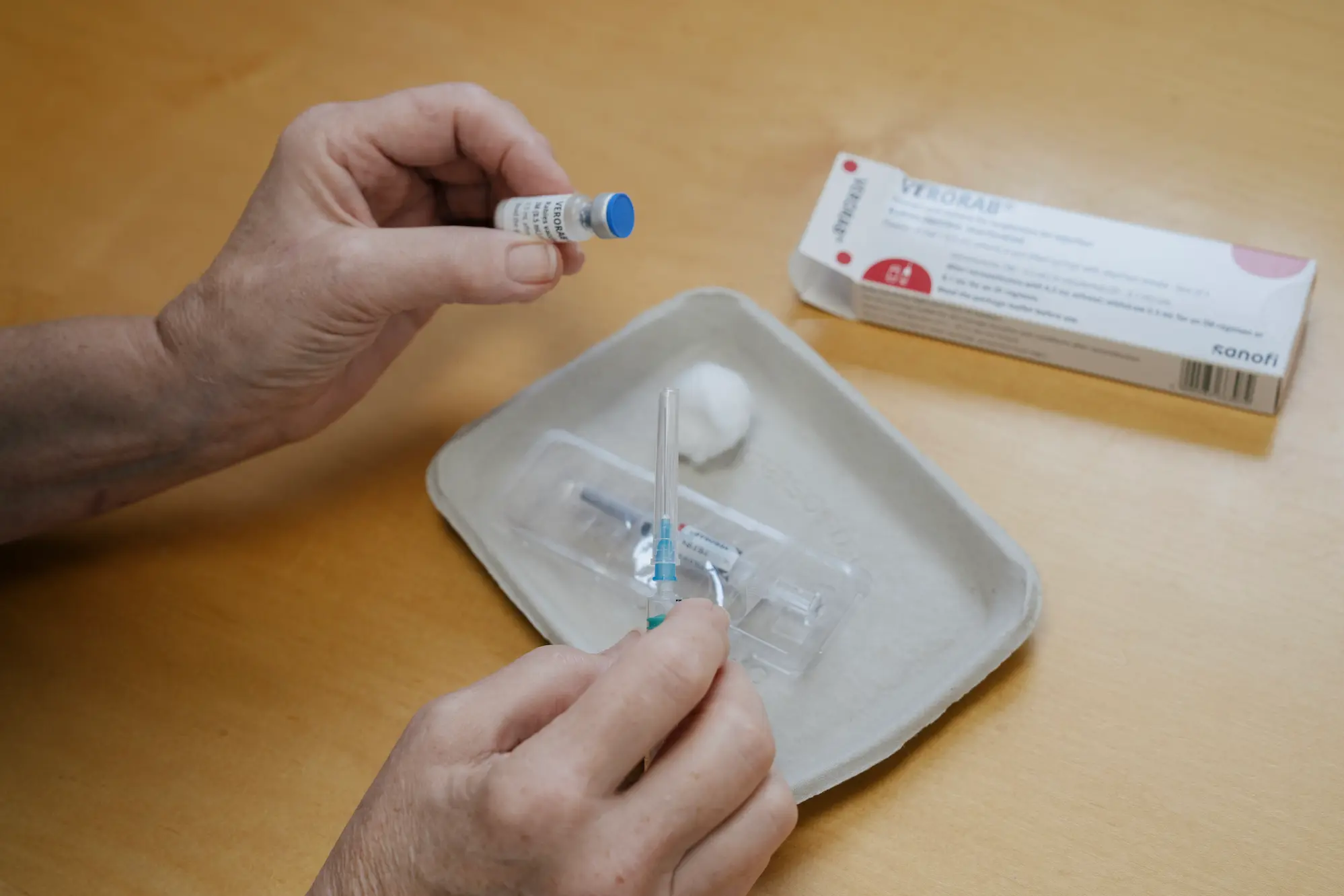
- Anti-HBs is the antibody test that shows whether someone has responded to hepatitis B vaccination.
- A level of 100 mIU/ml or more is taken as a satisfactory response; under 10 mIU/ml is a non-responder; 10–100 is an intermediate response.
- The strictest requirements apply to workers who perform exposure prone procedures (EPPs), where additional health clearance is required.
- Clearing a worker for EPPs is a specialist occupational health decision, not an administrative tick – and it rests on identified, validated blood samples.
Few pieces of occupational health generate as many confused emails as hepatitis B clearance. An employer knows their staff need to be "protected", a new nurse arrives with a hazy vaccination history, someone mentions a number that has to be "over 100", and a phrase like "exposure prone procedures" gets used without anyone being quite sure what it captures. It matters, because hepatitis B is a serious bloodborne virus and healthcare workers are at real risk of exposure – but the framework, once laid out plainly, is logical. This is the practical detail behind a common compliance headache: what the numbers mean, who needs what, and where the real decisions sit.
Two different questions
The single most useful thing to understand is that hepatitis B clearance answers two separate questions, and confusing them causes most of the muddle.
The first is: is this worker protected against hepatitis B? That's about vaccination and the antibody response to it – relevant for most people with patient contact, to protect the worker.
The second is: could this worker pose a risk to patients? That's about whether the worker themselves carries a bloodborne virus, and it applies specifically to those performing exposure prone procedures. This is additional health clearance, and it exists to protect patients.
Most staff only engage with the first question. The second is a higher bar that applies to a defined group – and knowing which question you're answering tells you which rules apply.
Clearing someone for exposure prone procedures is a clinical judgement, not an administrative tick.
Understanding anti-HBs numbers
Protection from the hepatitis B vaccine is measured by the anti-HBs antibody level, checked one to two months after completing the primary vaccine course. The response bands are where the "over 100" folklore comes from, and they're worth stating precisely:
100 mIU/ml or above – a satisfactory response. An immunocompetent healthcare worker who is a known responder does not, under current Green Book advice (updated in 2024), need routine boosters.
10 to 100 mIU/ml – an intermediate response. Protective, but a reinforcing (booster) dose is advised to lift the level.
Below 10 mIU/ml – classed as a non-responder. This group needs further management: a repeat vaccine course, and – importantly – testing for current hepatitis B infection.
Key point: "Over 100" is shorthand for a full satisfactory response, but the number that changes management most is 10. Below it, a worker is a non-responder and must be assessed for infection – not simply revaccinated and forgotten.
Non-responders: what actually happens
Around 10 to 15% of people don't mount an adequate response to a standard hepatitis B course, and the likelihood rises with certain factors – notably age over 40, obesity and smoking. A non-responder is not a crisis, but it does need a defined pathway: a repeat course of vaccine, and testing for hepatitis B surface antigen (HBsAg) to establish whether the reason they have no antibodies is that they're actually infected. A genuine, confirmed non-responder who is not infected can still work – they simply need to know that they're not protected, and post-exposure prophylaxis becomes the plan if they ever have a significant exposure. Crucially, for staff who do not perform EPPs or work in renal units, declining vaccination or failing to respond to it does not affect their employment. The stakes rise specifically around EPPs.
Exposure prone procedures and additional clearance
Exposure prone procedures are, broadly, those where there's a risk that injury to the worker could expose a patient's open tissues to the worker's blood – think of certain surgical, dental and midwifery procedures where hands work in confined spaces alongside sharp instruments or bone. Where a role involves EPPs, additional health clearance is required, and it must be based on an identified, validated sample (IVS) – a blood sample taken under conditions that confirm it truly belongs to that worker, precisely because the consequences of getting identity wrong are so serious. Where testing shows that a worker is living with a bloodborne virus, the bar is more detailed still: clearance then depends on two identified validated samples, taken at least four weeks apart, both showing a viral load below the threshold set in the guidance.
The framework here is the UK integrated guidance on health clearance and the management of healthcare workers living with bloodborne viruses, and it's exacting for good reason. The decision to clear an individual to perform EPPs rests with an accredited specialist in occupational medicine, in consultation with treating physicians where relevant – not with HR, and not with a checklist. There are also continuity rules: a worker who started EPP practice after 2007 should be able to show evidence of their clearance, and it's their responsibility to obtain it from a previous employer when they move. If that evidence can't be produced, they're treated as new, and clearance is done again.
In practice: A newly qualified midwife joins a unit where she'll perform EPPs. Occupational health confirms a full hepatitis B vaccine course, checks her anti-HBs (comfortably above 100), and – because the role involves EPPs – arranges the additional bloodborne virus clearance on an identified validated sample. Two weeks of proper process, and she starts EPP work fully cleared, with records that would satisfy any audit.
One more risk: reactivation
There's a subtlety worth flagging, because it catches people out. A worker who has, or has previously had, hepatitis B and has been cleared for EPPs can be at risk of the virus reactivating if they later become immunosuppressed – through illness or treatment. Anyone in that position has a responsibility to tell occupational health if they start immunosuppressive therapy or develop an illness affecting their immune system, so their clearance can be reviewed. It's a reminder that clearance is a living status, not a one-off certificate.
Getting it right without the headache
For an employer, the practical path is less daunting than the terminology suggests:
- Establish, for each role, whether it involves patient contact, EPPs, or renal-unit duties – this determines the level of clearance needed.
- For patient-facing staff, confirm hepatitis B vaccination and a satisfactory anti-HBs response, managing intermediate responders and non-responders per the pathway.
- For EPP roles, arrange full bloodborne virus clearance on an identified validated sample, decided by a specialist in occupational medicine.
- Keep clear, retrievable records – clearance evidence needs to travel with the worker and satisfy audit.
- Have a route for workers to report new immunosuppression so cleared status can be reviewed.
This is core occupational health territory, and the reason it's worth doing with a proper service is precisely that the decisions – interpreting an intermediate anti-HBs, managing a non-responder, clearing someone for EPPs on a validated sample – are clinical judgements with real consequences. Our immunisation and screening by role tool helps you map what each post requires, our pre-employment health assessment builds hepatitis B status checking in at the front door, and our clinical team provides the occupational health support and specialist decision-making behind EPP clearance.
Get the framework right once, and hepatitis B clearance stops being a recurring headache and becomes a quiet, well-documented routine.
This article is general guidance for employers and is not individual medical or legal advice. If you are unsure how it applies to your organisation, contact our team.