

- Ill health accounted for 35.0 million of the 39.6 million working days lost in 2025/26, and £17.6 billion of the £24.6 billion annual cost of work-related ill health and injury.
- Stress, depression or anxiety affected 891,000 workers and caused 52% of the working days lost to ill health, an average of 20.4 days for each case.
- Around 13,000 deaths a year are linked to past exposure at work, mainly to chemicals or dust. Health surveillance finds the early signs of disease in people exposed today.
- Employers have a legal duty to assess the risk of work-related stress and act on it. Early conversations and early referral to occupational health help people stay in work.
The Health and Safety Executive (HSE) published its annual statistics for Great Britain on 19 November 2026. An estimated 1.8 million workers had an illness caused or made worse by work in 2025/26, and work-related ill health and injury cost 39.6 million working days. Ill health, rather than injury, accounted for most of that loss. For employers, that points to two areas where occupational health can prevent harm or limit it – early support for mental health, and health surveillance for people exposed to hazards at work.
What the 2026 figures show
Of the 1.8 million workers with work-related ill health in 2025/26, 699,000 were new cases that year. Ill health accounted for 35.0 million of the 39.6 million working days lost, and workplace injuries for the other 4.6 million.
HSE puts the annual cost of workplace injury and new cases of work-related ill health at £24.6 billion in 2024/25, at 2025 prices and excluding long-latency illness such as cancer. Ill health makes up £17.6 billion of this. HSE estimates that individuals bear £14.5 billion of the total, government £5.4 billion and employers £4.6 billion.
The headline numbers are lower than in last year's release, which reported 1.9 million workers with work-related ill health and 964,000 with stress, depression or anxiety in 2024/25. HSE says the 2025/26 rate of stress, depression or anxiety is not statistically different from the previous year. The overall rate of work-related ill health has been broadly flat for four years and remains higher than before the pandemic.
"Most of the harm in these figures is ill health that builds up over months or years. That gives employers time to act, provided someone is looking for the early signs." – Dr Stewart Tomlinson, Medical Director
Stress, depression and anxiety
Stress, depression or anxiety caused or made worse by work affected 891,000 workers in 2025/26, 49% of all work-related ill health. There were 357,000 new cases, and 18.2 million working days were lost (HSE stress statistics).
Over the three years to 2025/26, rates were significantly higher than average in public administration and defence, health and social work, and education, and in professional occupations. HSE's most recent data on causes, from 2009/10 to 2011/12, found that the main work factors were workload pressures, including tight deadlines and too much responsibility, and a lack of managerial support.
Acting early on mental health
Employers have a legal duty to protect workers from stress at work by doing a risk assessment and acting on it (HSE). HSE names six areas of work that can lead to work-related stress if they are not managed properly – demands, control, support, relationships, role and change. Its Management Standards give employers a way to assess each one, and our guide to carrying out a stress risk assessment sets out the steps.
A risk assessment deals with the causes across a team. For individuals, the National Institute for Health and Care Excellence recommends training for managers in its guidance on mental wellbeing at work. That training can cover how to identify early warning signs and how to have a conversation about mental wellbeing. The guidance also recommends giving managers the authority to adjust workload or work intensity, for example through flexible or hybrid working.
Timing matters for any health-related absence. The government's Keep Britain Working update of September 2026 notes that someone absent for four to six weeks has a 96% chance of returning to work. After a year, fewer than half return.
"When someone is struggling, the first few weeks matter most," says Dr Stewart Tomlinson. "A change to workload, hours or duties at that point can often keep them at work. After months of absence, getting back is much harder."
An occupational health referral at this stage gives the manager independent advice on what the person can do now, which adjustments would help and when to review them.
In practice
For example, a council housing team carries out a stress risk assessment using a short staff survey and small-group discussions. The results point to demands and change – back-to-back appointments, a new case system introduced with little training, and emails arriving late in the evening. The team chooses its own changes. The first two hours of each morning are kept free for casework, and messages written in the evening are scheduled to send the next morning. A shared caseload board lets the manager see who is overloaded and move work. Staff who know the new system well are paired with those still learning it. Anyone already struggling is referred to occupational health early, with their agreement, and the survey is repeated after six months to check what has changed.
Musculoskeletal disorders
Musculoskeletal disorders affected 477,000 workers in 2025/26, 26% of all work-related ill health, and caused 7.5 million lost working days. There were 172,000 new cases. Back problems made up 38% of cases, upper limb or neck problems 37% and lower limb problems 25%. Over the three years to 2025/26, rates were higher than average in construction and in transportation and storage.
HSE advises employers to encourage workers to report symptoms early, and notes that people with musculoskeletal disorders usually recover completely if the problem is recognised early and treated appropriately (HSE). A referral when symptoms first affect work can lead to changes to tasks or the workstation and, where needed, to physiotherapy. Our article on managing musculoskeletal disorders at work covers this in more detail.
Disease from past exposure
Around 13,000 deaths each year are estimated to be linked to past exposure at work, mainly to chemicals or dust, and most are from lung disease. Chronic obstructive pulmonary disease accounts for 36% of the lung disease deaths, lung cancer not linked to asbestos for 23%, mesothelioma for 19% and asbestos-related lung cancer for 19%.
These deaths reflect exposures from years or decades ago, but lung disease is still being caused now. HSE estimates 22,000 new cases a year of breathing or lung problems caused or made worse by work, averaged over 2023/24 to 2025/26. The rate of new occupational asthma cases reported by chest physicians has been broadly constant since 2010.
How health surveillance prevents disease
HSE defines health surveillance as a scheme of repeated health checks used to identify ill health caused by work (HSE). The law requires it where workers remain exposed to a risk to health after controls are in place, for example from noise, vibration or substances hazardous to health. For some hazards, including asbestos, lead and ionising radiation, the law requires medical surveillance by a doctor appointed by HSE, apart from some lower-risk asbestos work.
The checks depend on the hazard. Examples are lung function tests for people exposed to dust or fumes, skin checks for people who do wet work or handle irritants, hearing tests for people exposed to noise, and assessments for people who use vibrating tools.
HSE's guidance on occupational asthma sets out why early detection matters. If symptoms are picked up early and the exposure of a sensitised (allergic) worker is changed, the risk of developing long-term asthma is reduced. Where occupational asthma is identified, the employer must review its risk assessment and controls. Health surveillance does not replace a risk assessment or exposure controls. It shows whether they are working.
"Health surveillance picks up early changes, such as a small fall in lung function or the first signs of dermatitis, while there is still time to reduce the exposure," says Dr Tomlinson. "Its value depends on what the employer does with the results."
In practice
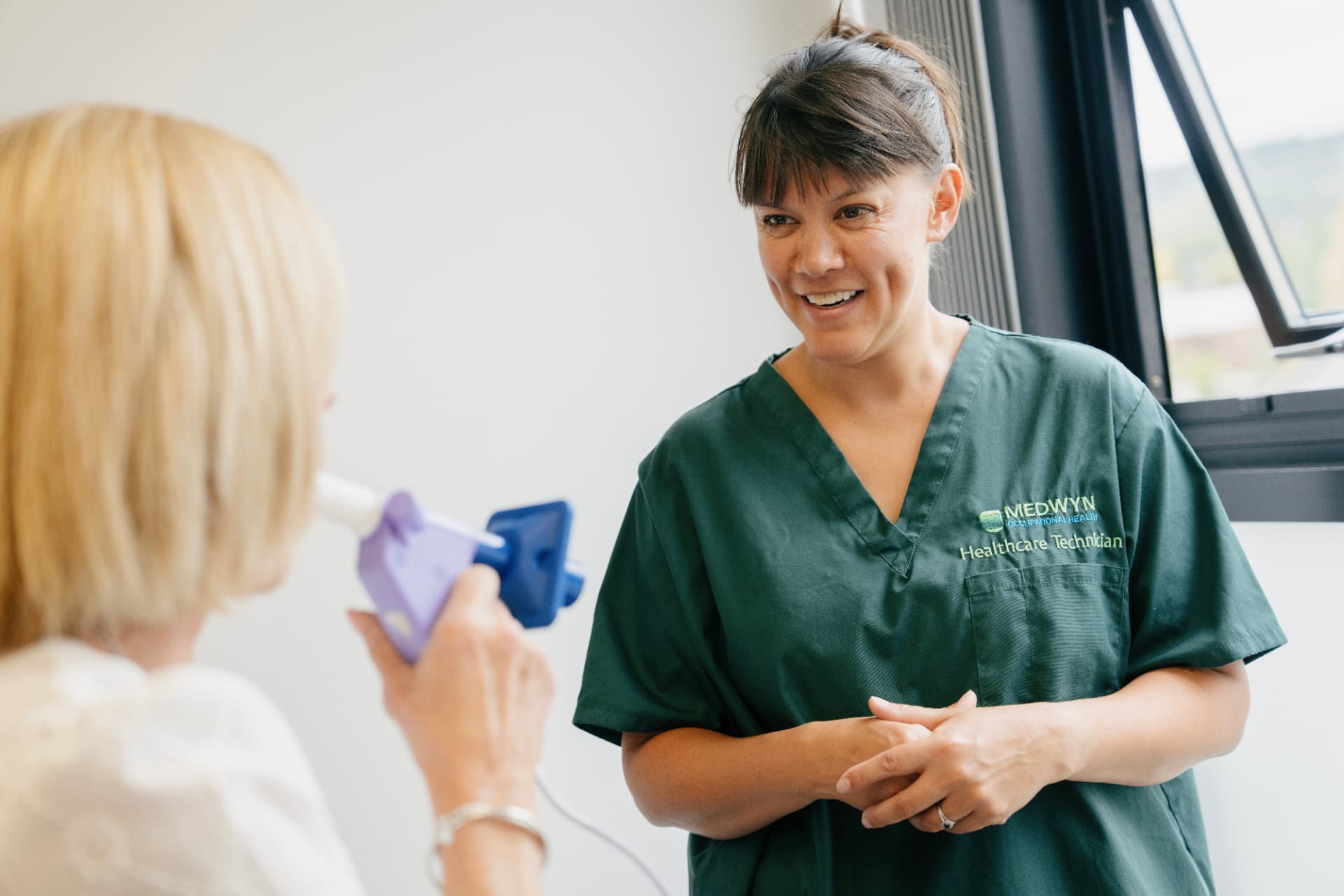
For example, annual lung function testing at a joinery workshop shows a fall in one worker's results compared with the year before. The occupational health advisor reviews their symptoms and arranges further assessment. The employer has the dust extraction on that worker's machine checked and finds it needs repair.
What employers can do now
- Check that risk assessments cover health hazards such as dust, fumes, noise, vibration and skin exposure, as well as safety.
- Confirm who needs health surveillance, that new starters have a baseline check, and that results are reviewed and acted on.
- Carry out a stress risk assessment, using HSE's Management Standards or a similar approach, and act on the findings.
- Give managers the training and the authority to have early conversations and make short-term changes to workload.
- Refer to occupational health when health first starts to affect work, not only after a long absence.
- Track sickness absence and its causes so you can see where problems are building.
How Medwyn can help
We run health surveillance programmes at our clinic in Dorking and at employers' premises, with results reviewed by our clinical team. Our occupational health physicians and advisors also carry out management referrals, provide mental health support and assess musculoskeletal problems, arranging physiotherapy through our network of registered physiotherapists. To discuss your workforce, send an enquiry.
This article is general guidance for employers and is not individual medical or legal advice. If you are unsure how it applies to your organisation, contact our team.